| Nyogen Nowak |
Zen art, the aims of which are to teach and to inspire, should be contemplated rather than merely viewed. Traditionally every scroll was displayed in the finest receiving room of a temple or house, allowing a visitor to contemplate the picture quietly. Exhibitions of Zen art are often held not only in museums and galleries, but also in the meditation halls of temples.
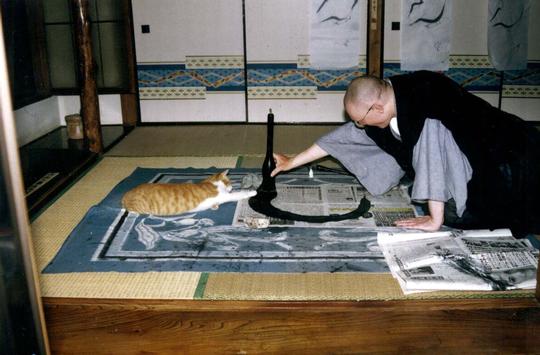
The most important element in Zen painting (zenga) and Zen calligraphy (zensho) is the flow of vital life energy through the ink (bokki). We can say that this is the most precious secret of Zen art. In oriental ink painting in general and in zenga in particular, what is most important is the line. If the line is full of vital life energy, the whole painting is lively and has amazing power. It does not depend on the painting technique or on the quality of the paper, ink or brush. It depends only on this vital energy, which is always present, but which remains hidden if not cultivated. Thus, Zen art is part of Zen training. Zazen is one of the ways of cultivating this energy.
Born on September 24, 1956, in Wrocław, Poland. At the age of fifteen he developed an interest in Buddhism and Buddhist art, and in 1974 he began practicing zazen. In 1980 he was ordained as a Zen monk at an American Zen center.
In 1982, while in Los Angeles, a Korean Zen monk introduced him to zenga painting. In 1983 he traveled to Japan for the first time to meet his teacher, Harada Tangen Rōshi, abbot of Bukkokuji Temple in Obama, Fukui Prefecture, under whose guidance he continued his training until April 2012, when Rōshi retired from teaching due to age and health.
Encounters with original works of Japanese Zen calligraphy and painting, together with encouragement from his teacher and other priests, led zenga painting to become an integral part of his zazen practice. While in Japan he was re-ordained within the Sōtō Zen tradition and received Dharma transmission (shihō) from Harada Tangen Rōshi.
In 1995 he received a scholarship from the Yokohama Zenkoji Scholarship Foundation for International Buddhist Study. He has lived in Sendai since 1989 and is a member of ZPAP (Association of Polish Artists and Designers).
Major exhibitions: